
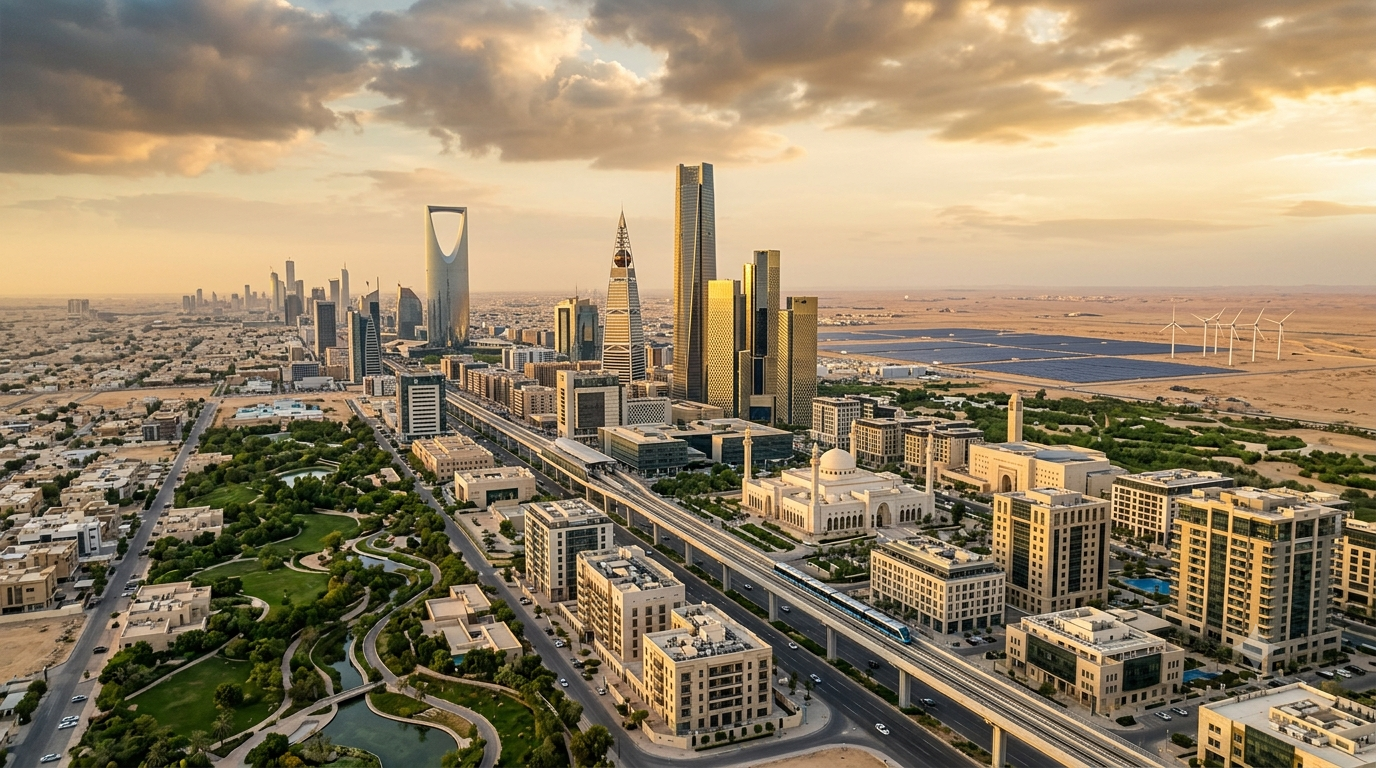
“Vision 2030 is not simply an economic plan. It is an attempt to redefine how Saudi Arabia sees itself and how the world sees the Kingdom.”
To many Western observers, Saudi Arabia’s transformation appears as a series of separate headlines: a new city in the desert, global sporting events, luxury tourism, women entering new sectors of work, renewable energy projects, foreign companies moving to Riyadh, and billion-dollar investments in technology, entertainment and infrastructure. But these are not disconnected stories. They are part of a wider national blueprint: Vision 2030.
To understand the new Saudi Arabia, the West must first understand the plan behind the change.
For decades, Saudi Arabia was viewed internationally through a narrow lens: oil wealth, religious significance, desert geography and geopolitical influence. That image is no longer sufficient. Under Vision 2030, the Kingdom is attempting one of the most ambitious national transformations in the world. Its aim is not simply to modernise a few sectors, but to reshape the country’s economy, society, global image and future role.
This is why Vision 2030 matters. It is not just a development plan. It is the framework through which Saudi Arabia is trying to redefine itself.
A national blueprint, not a publicity campaign
Vision 2030 was launched to reduce Saudi Arabia’s dependence on oil, diversify the economy, improve quality of life, attract investment and create new opportunities for citizens. Its official framework is built around three broad pillars: a vibrant society, a thriving economy and an ambitious nation [1].
Those phrases may sound simple, but they reveal the scale of the project. A “vibrant society” points to culture, lifestyle, tourism, entertainment, sport and quality of life. A “thriving economy” points to investment, jobs, private-sector growth, non-oil industries and global competitiveness. An “ambitious nation” points to government reform, efficiency, transparency and national delivery.
This makes Vision 2030 different from a traditional economic plan. It connects social reform, economic diversification, cultural development, tourism, infrastructure, investment and sustainability into one national narrative. For Western readers, this is important because Saudi Arabia is often judged through isolated events. Vision 2030 shows that the changes taking place in the Kingdom are not random. They are connected by a long-term strategy.
From oil economy to investment powerhouse
Saudi Arabia is not denying its oil history. Instead, it is trying to use the wealth, infrastructure and global influence created by oil to build a broader economic future. That is a more accurate and more powerful way to understand the Kingdom’s transformation.
One of Vision 2030’s core ambitions is to position Saudi Arabia as a global investment powerhouse and as a hub connecting Asia, Europe and Africa [2]. This is central to the Kingdom’s new identity. Saudi Arabia does not want to be seen only as a supplier of oil. It wants to be seen as a centre for capital, projects, logistics, tourism, innovation and future industries.
The Public Investment Fund is a key part of this model. The fund has become one of the main engines of Saudi economic transformation, supporting sectors such as tourism, entertainment, technology, renewable energy, urban development, logistics and advanced manufacturing. In 2025, the official Vision 2030 annual reporting stated that PIF assets under management had expanded to hundreds of billions of dollars, showing the scale of capital being mobilised for the transformation [3].
This is one of Saudi Arabia’s greatest advantages. Many countries have ambitions. Far fewer have a national vision backed by sovereign capital, strategic geography, energy expertise and political focus.
The West sees fragments; Saudi Arabia sees a strategy
Western commentary often treats Saudi Arabia’s reforms as separate stories. A football signing is discussed as sport. A tourism project is discussed as travel. NEOM is discussed as a futuristic city. Renewable energy is discussed as climate policy. Women’s workforce participation is discussed as social reform. But Vision 2030 connects all these developments into a single story of national repositioning.
This is where The Kingdom Review’s core argument becomes important: Saudi Arabia is not simply changing its image; it is changing the architecture of its future.
Tourism is not just about visitors. It is about jobs, hospitality, global image and economic diversification. Sport is not just entertainment. It is about soft power, youth culture, international attention and the events economy. Renewable energy is not just climate policy. It is about future competitiveness and preserving Saudi Arabia’s role as an energy leader in a changing world. Women’s participation in the workforce is not only a social change. It expands the labour market, raises household income and strengthens the private sector.
This is the joined-up nature of Vision 2030. It gives Saudi Arabia a clearer direction than many Western readers may assume.
Tourism as proof of transformation
Tourism is one of the clearest examples of how quickly the Kingdom’s image is changing. For many years, Saudi Arabia was not viewed as a mainstream tourism destination by Western travellers. Today, tourism is one of the central pillars of national diversification.
Saudi Arabia achieved the milestone of more than 100 million tourist visits in 2023, a target that was originally associated with Vision 2030 ambitions and was reached ahead of schedule [4]. This figure includes domestic and international tourism, but its significance should not be underestimated. It shows that tourism is no longer a side project. It is becoming a serious economic sector.
Destinations such as AlUla, Diriyah, the Red Sea, Riyadh, Jeddah and Asir are helping to reintroduce the country to the world. They show a Saudi Arabia that is historical, geographical, cultural and increasingly open. For Western audiences, this challenges the old image of the Kingdom as closed, inaccessible or one-dimensional.
Saudi Arabia is not merely asking people to change their opinion. It is building the destinations, infrastructure and experiences that make a different opinion possible.
Social and labour-market change
One of the most important but sometimes underappreciated parts of Vision 2030 is the transformation of the Saudi labour market. A national transformation cannot succeed unless citizens are included in it, and the Kingdom has made notable progress in employment and workforce participation.
Reuters reported that Saudi unemployment fell to 7.1% in the second quarter of 2024, while women’s participation reached 35.4%, surpassing the original Vision 2030 target [5]. This is significant because it shows that Vision 2030 is not only about mega-projects. It is also about people entering new areas of work, private-sector employment, women’s economic participation and a younger generation preparing for a different economy.
For Western readers, this is one of the strongest ways to challenge outdated perceptions. The Kingdom is often discussed through the lens of restriction, but the labour-market data shows a society undergoing visible economic and social change.
This does not mean every challenge has disappeared. No national transformation of this scale is simple. But it does mean that Saudi Arabia is not static. The country is moving, reforming and creating new pathways for its citizens.
Riyadh as a business capital
Another sign of transformation is Riyadh’s emergence as a regional business hub. Saudi Arabia has encouraged multinational companies to establish regional headquarters in the Kingdom, particularly if they wish to secure government contracts. Reuters reported that 675 companies had established regional headquarters in Riyadh as part of this wider strategy [6].
This matters because it shows that Vision 2030 is not only about domestic change. It is also about repositioning Saudi Arabia within the global business map. Riyadh is being developed not simply as a capital city, but as a commercial centre intended to compete for investment, talent, corporate presence and regional influence.
For Western companies, this is a practical reason to pay attention. Saudi Arabia is not just a market to observe from outside. Increasingly, it is a market where companies may need a presence, a strategy and local understanding.
A clearer vision than Western fragmentation
A promotional article must make a positive case, but it should do so carefully. It would be inaccurate to claim that Saudi Arabia is ahead of every Western country in every area of transformation. Some Western countries have more developed renewable-energy sectors, older tourism industries and longer-established institutions.
But Saudi Arabia can be compared favourably in another way: strategic coherence.
Many Western countries struggle with fragmented policy, short election cycles, local opposition to infrastructure, changing regulations and political division. Long-term projects can be delayed by shifting governments, planning disputes or public disagreement. Saudi Arabia’s advantage is that Vision 2030 provides one national direction linking economy, society, investment, tourism, culture, infrastructure and sustainability.
This is the point Western readers should understand. Saudi Arabia’s strength is not that every target has already been completed. Its strength is that the Kingdom has created a long-term national story and is aligning institutions, investment and public ambition around it.
In a world where many countries struggle to define a future beyond short-term politics, Saudi Arabia has placed transformation at the centre of national identity.
Progress, recalibration and realism
A credible article should not pretend that transformation is easy. Vision 2030 is ambitious, and some projects have faced delays, cost pressures and recalibration. Reuters has reported challenges around some Saudi giga-projects, including write-downs and reassessments linked to costs, timelines and changing priorities [7].
But this does not disprove the transformation. In many ways, it shows the seriousness of the process. Large national projects often evolve. Priorities change. Timelines are adjusted. Budgets are reviewed. What matters is whether the overall direction remains intact.
In Saudi Arabia’s case, the direction remains clear: diversification, investment, tourism, sustainability, business development and national modernisation. The Kingdom is learning how to balance ambition with delivery. That is not a weakness unique to Saudi Arabia. It is the reality of any country attempting transformation at scale.
Why the West should look again
For Western audiences, Vision 2030 should be taken seriously because Saudi Arabia is not a marginal country. It is a major energy power, a G20 economy, the heartland of Islam, a strategic bridge between continents and one of the most important investment stories in the Gulf.
If Vision 2030 succeeds, its impact will not be limited to Saudi Arabia. It could reshape regional tourism, energy markets, investment flows, logistics routes, cultural exchange and Western business engagement with the Gulf. It could also change the way the West understands Saudi society.
That is why old assumptions are no longer enough. The Kingdom cannot be understood only through oil, nor only through criticism, nor only through stereotypes. It must be understood through what it is building.
Conclusion: the Kingdom reimagined
Vision 2030 is the blueprint behind Saudi Arabia’s new story. It explains why the Kingdom is investing in tourism, opening new sectors, building renewable energy, attracting foreign companies, expanding entertainment, encouraging workforce participation and repositioning Riyadh as a global business centre.
The transformation is not complete. It will face challenges, delays and scrutiny. But it is real, visible and increasingly difficult to ignore.
For too long, Saudi Arabia has been judged in the West by its past. Vision 2030 asks the world to judge it also by its future. That future is not only about moving beyond oil. It is about building a more diversified, ambitious and globally connected Kingdom.
To understand Saudi Arabia today, the West must look beyond the old image. It must look at the blueprint and at the country now being built from it.
Sources and Further Reading
1. Saudi Vision 2030, Vision 2030 Overview and Strategic Objectives, official Vision 2030 website.
2. Saudi Vision 2030, Saudi Arabia: The Heart of the Arab and Islamic Worlds, an Investment Powerhouse and a Hub Connecting Three Continents, official Vision 2030 documentation.
3. Public Investment Fund, Annual Report / Assets Under Management, official PIF publication.
4. UN Tourism, Saudi Arabia Reaches 100 Million Tourists, official UN Tourism announcement, 2024.
5. Reuters, report on Saudi unemployment and women’s labour-force participation.
6. Reuters, report on international companies establishing regional headquarters in Riyadh.
7. Reuters, report on the reprioritisation and recalibration of Saudi giga-projects.