
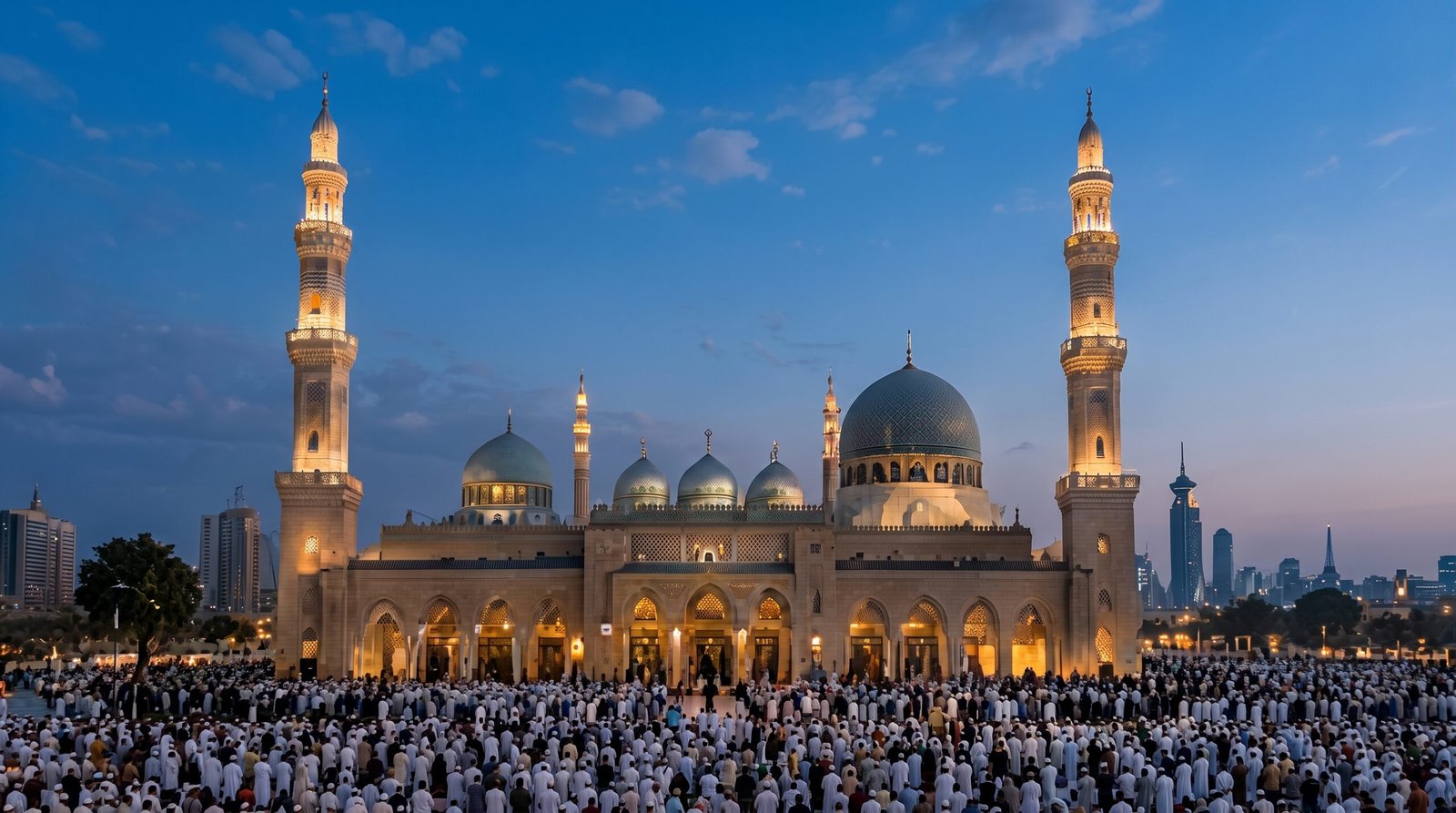
When Western audiences discuss Saudi soft power, the conversation usually turns to football, tourism, entertainment, investment and mega-projects. These are visible instruments of influence, but Saudi Arabia’s deepest source of global authority is older: its position as the land of Makkah and Madinah.
That religious position cannot be manufactured by a stadium or investment fund. It connects the Kingdom to Muslims across every continent and gives Saudi Arabia an unusual role in how Islam is represented internationally. The Muslim World League, headquartered in Makkah, sits at the centre of that responsibility.
Soft power is influence achieved through attraction and persuasion rather than coercion or payment.[1] Viewed through that lens, the League is more than a religious organisation. It is one of the clearest examples of how Saudi Arabia is trying to turn religious standing into dialogue, humanitarian action and global credibility.
The influence Saudi Arabia already possesses
The Muslim World League was established in Makkah in 1962 following a resolution of the World Muslim Congress. It describes itself as an independent international Islamic organisation whose objectives include moderation, dialogue, Muslim unity and support for Muslim minorities within the constitutional frameworks of the countries where they live.[2]
Its history, however, is inseparable from Saudi religious influence. Academic research describes an organisation that originally concentrated on propagating Islamic fundamentals in line with the Saudi state’s outlook, before substantially expanding its interfaith programme after Mohammed Al-Issa became secretary-general in 2016.[3] External analysts have therefore interpreted its newer agenda as part of a broader Saudi effort to redirect the Kingdom’s international religious message.[8]
That change is the heart of the story. The League is not abandoning Islamic identity to appear modern. It is presenting moderation, coexistence and responsible citizenship as expressions of that identity. For Saudi Arabia, this creates a form of influence that sport or tourism cannot provide: the ability to speak about meaning, belonging and moral responsibility.
From declaration to visible diplomacy
The most important statement of this agenda is the Charter of Makkah, endorsed in 2019 by more than 1,200 Muslim figures from 139 countries. The Charter argues that religious and cultural diversity should lead to dialogue rather than conflict. It supports equal human dignity, global citizenship, protection of places of worship, responsible national belonging and action against hatred, violence and extremism.[4]
Its significance lies partly in where it was issued. By placing these principles under the moral authority of Makkah, the League presented coexistence not as a concession imported from outside Islam, but as a position grounded within Islamic scholarship. That is a more persuasive message for Muslim communities than a generic public-relations campaign.
The message became tangible in January 2020, when Al-Issa led a delegation of 62 Muslims from 28 countries to Auschwitz-Birkenau alongside the American Jewish Committee. The AJC described it as the most senior Islamic leadership delegation ever to visit a Nazi German death camp.[5] The visit was powerful because it moved beyond conference language: a senior Saudi religious figure publicly confronted antisemitism and Holocaust denial through presence and remembrance.
The League has also directed its bridge-building inward. Its 2025 conference on Islamic schools of thought and sects sought to strengthen solidarity around shared values while countering sectarian rhetoric and practices.[6] This matters because religious diplomacy is not credible if it promotes harmony abroad while ignoring division within the Muslim world.
Humanitarian Islam
Religious diplomacy becomes more convincing when it is connected to service. Through multi-year agreements with UNHCR, the League contributed $1 million during 2020–2021 to youth and child-protection projects in Sudan, Ethiopia and Nigeria. In 2023 it made a further five-year pledge of $5 million for refugee livelihoods, inclusion and food security.[7]
Those figures are modest beside Saudi Arabia’s largest investments, but their meaning is different. They present Islamic ethics through protection, food security and dignity rather than through argument alone. The League’s endorsement of UNHCR’s Refugee Zakat Fund also connects a traditional religious obligation to an international humanitarian institution.[7]
Why Western audiences should pay attention
In much Western debate, Islam is still encountered through the language of extremism, migration, security and social conflict. The League’s modern agenda offers a different proposition: Muslim identity can support citizenship, interfaith cooperation and opposition to antisemitism, sectarianism and anti-Muslim hatred.
This does not mean Western concerns should be dismissed, or that every criticism of Saudi Arabia is Islamophobic. It means Islam should not be reduced to the actions of extremists, and Saudi religious influence should not be assessed only through its past. If the League’s change is real, Western institutions have an interest in examining it seriously rather than through inherited assumptions.
The organisation is also important because it is closely connected to Saudi Arabia’s changing national narrative. It speaks as an Islamic body, but its prominence also advances an image of the Kingdom as a convenor: a country able to bring scholars, faith leaders and humanitarian organisations together across borders.
The credibility test
That claim must still be tested. The League’s newer language does not erase decades in which Saudi religious outreach was criticised for exporting rigid or exclusionary interpretations. Analysts who recognise the change also argue that its significance depends on whether new messages alter institutions and practice, rather than merely improving presentation.[3][8]
Transparency is part of that test. The League says that endowments and the investments generated from them are major sources of funding.[2] Its public profile, however, does not provide consolidated financial detail sufficient for an outsider to assess the scale and distribution of its work comprehensively. That makes independent evaluation harder.
Impact matters as much as intention. Conferences, charters and symbolic visits are valuable, but the stronger measures are whether programmes reduce sectarian hostility, strengthen protection for minorities, improve refugee lives and build durable relationships between religious communities.
Nor is religious diplomacy a substitute for reform elsewhere. It does not settle debates about human rights, political freedoms or regional policy. Its importance is narrower but still substantial: it shows that Saudi Arabia’s transformation has a religious and civilisational dimension that economic reporting often overlooks.
Conclusion: faith as soft power
Saudi Arabia’s future will not be defined only by what it builds with oil wealth. It will also be defined by what it does with religious responsibility.
Through the Muslim World League, the Kingdom is presenting moderation, coexistence, humanitarian service and interfaith engagement as part of its international role. The Charter of Makkah, the Auschwitz visit, bridge-building between Islamic traditions and the UNHCR partnership give that message substance.
The League should neither be celebrated uncritically nor dismissed because of its history. It should be judged by consistency, transparency and results. If its agenda produces lasting trust, it could become one of Saudi Arabia’s most distinctive forms of influence, not sport diplomacy, tourism diplomacy or investment diplomacy, but faith as soft power.
Further Reading & Sources
1. Joseph S. Nye Jr., Harvard Kennedy School, “Soft Power and Public Diplomacy Revisited”, definition and discussion of soft power.
2. Muslim World League, “About the Muslim World League”, official profile, objectives and financial-management statement.
3. Mohammad Khalid Husain, “Interfaith Outreach of the Muslim World League: Trends, Causes, and Future Directions”, Politics and Religion Journal, vol. 16, no. 1, 2022, pp. 45–63; DOI: 10.54561/prj1601045h.
4. Muslim World League, The Charter of Makkah, issued 27–29 May 2019.
5. American Jewish Committee, “American Jewish Committee, Muslim World League Historic Joint Visit to Auschwitz”, 23 January 2020.
6. Muslim World League, “Building Bridges Between Sects”, 7 March 2025.
7. UNHCR Refugee Zakat Fund, “Muslim World League — Partner in Focus”, Annual Report 2024, with partnership commitments through 2023.
8. Sarah Feuer, The Washington Institute for Near East Policy, “Course Correction: The Muslim World League, Saudi Arabia’s Export of Islam, and Opportunities for Washington”, 22 November 2019.